Opposition
White to move: Draw
Black to move: White wins
The kings face each other with one square between them. Whoever must move gives way.
Key1…♔d7 2.♔f6
On the board: the Lucena position, king, rook and pawn against rook. Know it and you win the most common ending.
Endgame · technique · knowledge
Once most pieces are traded, exact knowledge decides. chessophia shows the positions you must know, with their verdict – win or draw – and the way there.
White to move. Click a piece, then its target square – or drag it.
Study by Georges Barbier and Fernando Saavedra, Glasgow 1895
Principles
Each basic position with its verdict in the result colours. Sometimes it only depends on who is to move.
Win Draw
The kings face each other with one square between them. Whoever must move gives way.
If the king is inside the pawn's square it catches it. Otherwise the pawn runs through.
The rook builds a bridge to shelter the king from side checks. The key winning position in rook endings.
Black's rook holds the 6th rank. Once the pawn advances, it checks from behind.
Against the rook pawn the rook attacks from the side and pins the pawn down.
The king chases two goals at once: catch the h-pawn and support its own c-pawn. Study by Richard Réti, 1921.
King and rook push the king to the edge rank by rank. Required from the first lesson.
The hardest basic mate: it only works in the corner the bishop controls.
The verdicts are established endgame theory. Stockfish's evaluations follow.
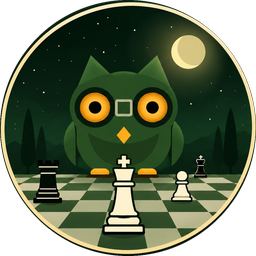
The emblem
The owl's eyes are two kings in opposition. The small square between them is the square fought over in pawn endings.
Sophia means wisdom. The owl sees in the dark, waits calmly and strikes at the right moment – like good endgame technique.
The family